I arrived at Abeba's house in Addis Ababa at seven in the morning, and she was already standing over a clay griddle in her kitchen, the mitad, with a bowl of batter in one hand and a ladle in the other. The griddle was hot enough to make the batter sizzle on contact. Abeba is the mother of my college friend Menna, who told me I had to spend a morning watching injera made from start to finish. "You can read about it all you want," Menna said. "But until you see the batter and smell it, you won't get it."
She was right. The batter was thin and pourable, like crepe batter, but with a deep, earthy brown-gray color. That comes from teff, a tiny grain that grows in the Ethiopian highlands and has been the foundation of the country's diet for over a thousand years. It is high in protein, iron, and calcium, and gluten-free. But those are nutrition facts. The reason Ethiopians eat it every day is how it tastes and what it does when you cook it.
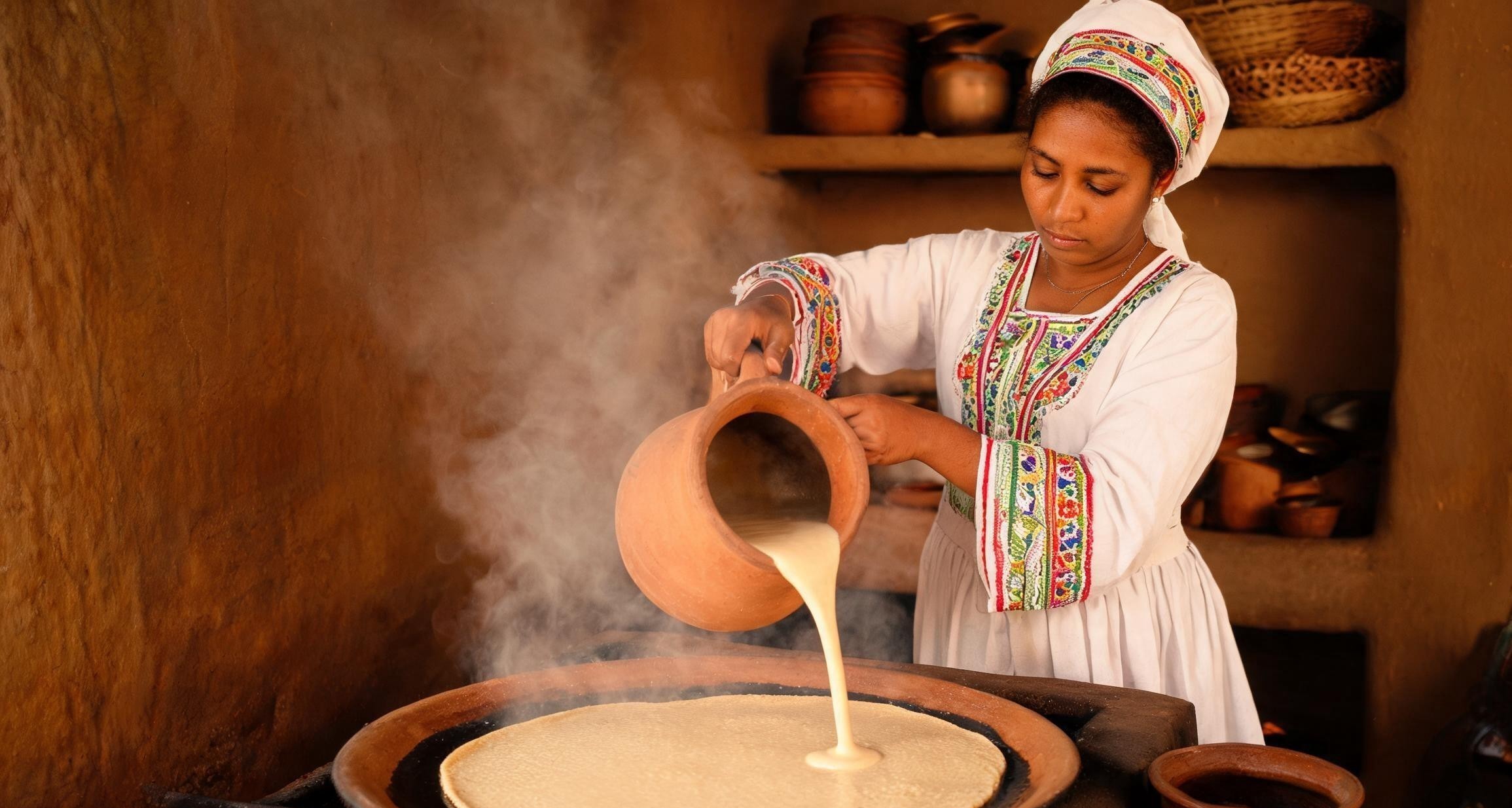
Abeba poured the batter onto the mitad in a wide circle, starting from the center and working outward in a spiral. She did this quickly, with a flick of the wrist that came from decades of repetition. Within seconds, small bubbles formed across the surface — these are what give injera its spongy texture, that honeycomb of tiny holes on the top side. The bottom, which cooks against the clay, comes out smooth and slightly crisp.
The key to injera is fermentation. Abeba started this batch three days earlier by mixing teff flour with water and leaving it on her counter. Wild yeast and the natural sugars in the teff do the rest. Over two or three days the mixture ferments, developing the tangy, sour flavor that defines injera. On the morning she cooks, Abeba saves a small portion as a starter for the next batch, the way you would with sourdough, then dilutes the rest with water to reach the right pouring consistency.
Each injera cooks in about two minutes. When the bubbles set and the edges pull away, Abeba slides a flat wooden spatula underneath and lifts it off in one piece. She makes six to eight pieces in about twenty minutes, each about two feet across and thin enough to see light through — soft and pliable on top, slightly chewy, with that bubbly surface that absorbs sauces and stews like a sponge.
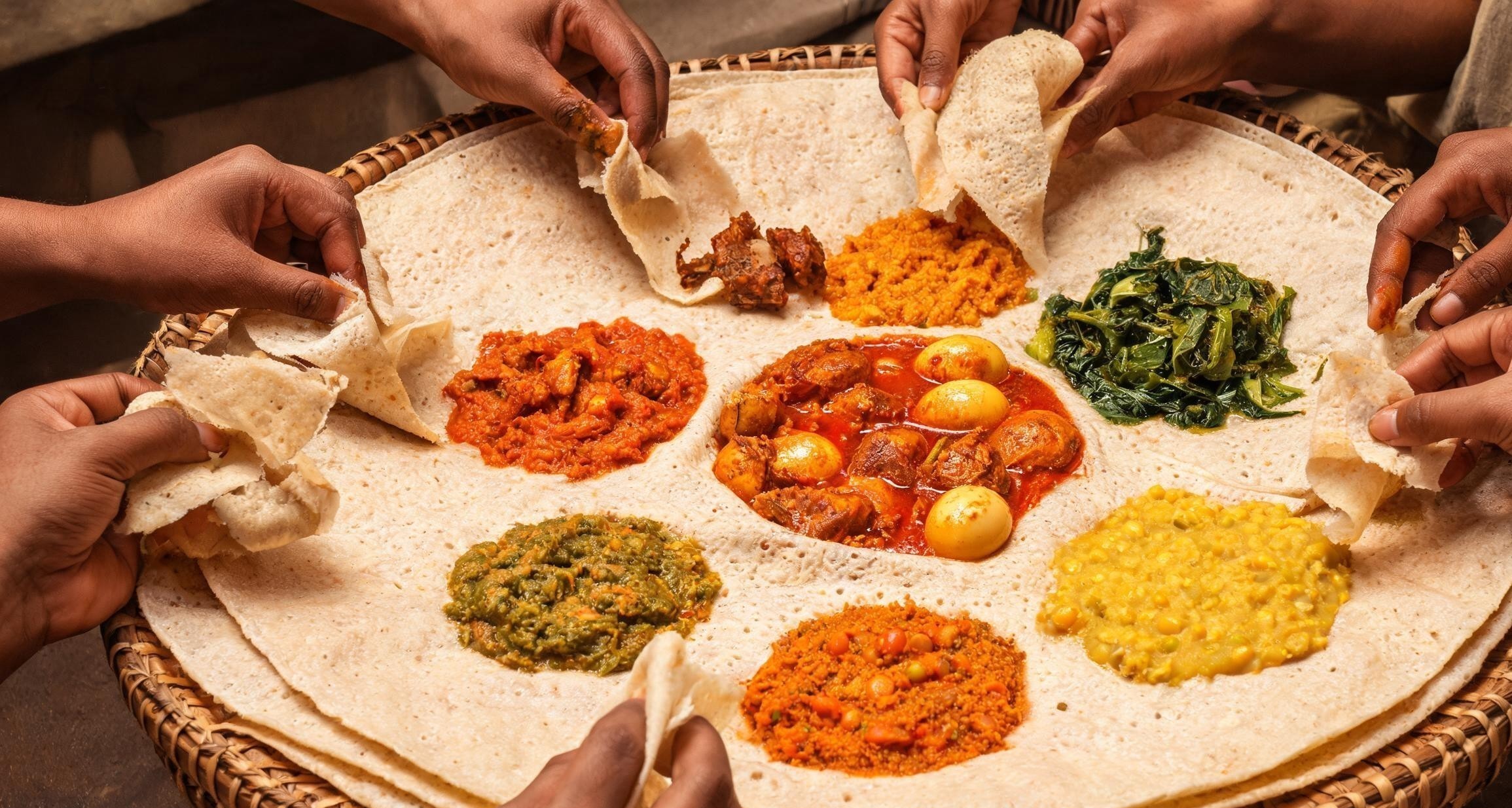
Injera is not just bread. It is also the plate and the utensil. Abeba placed a large injera on a round platter and arranged the wots on top in small mounds. You eat with your right hand, tearing off pieces from the edge and using them to pick up the stews. No forks, no spoons. The injera underneath soaks up the sauces and becomes the best part of the meal. That bottom piece, saturated with three different wots, is what people argue over at the table.
The wots Abeba prepared were the ones she makes most often. Doro wat, the chicken stew, starts with red onions sauteed in a dry pot — no oil at first, just onions and patience — until they break down into a dark paste, about forty minutes. Then she adds oil, berbere, and niter kibbeh, a spiced clarified butter, cooking the mixture into a rich, brick-red sauce. The chicken goes in next, bone-in, and simmers until falling apart. Hard-boiled eggs go in at the end, scored so the sauce seeps into the white.
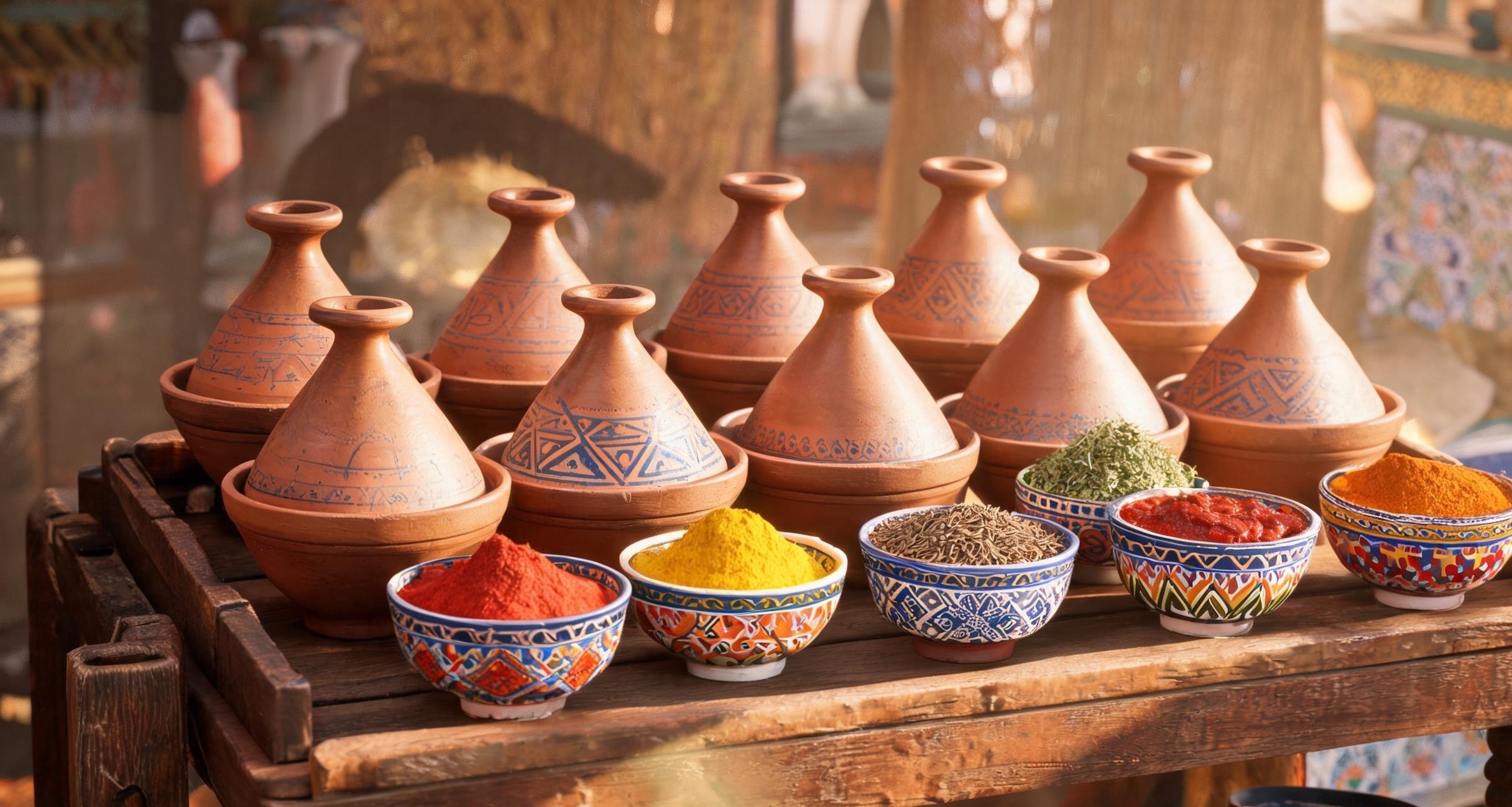
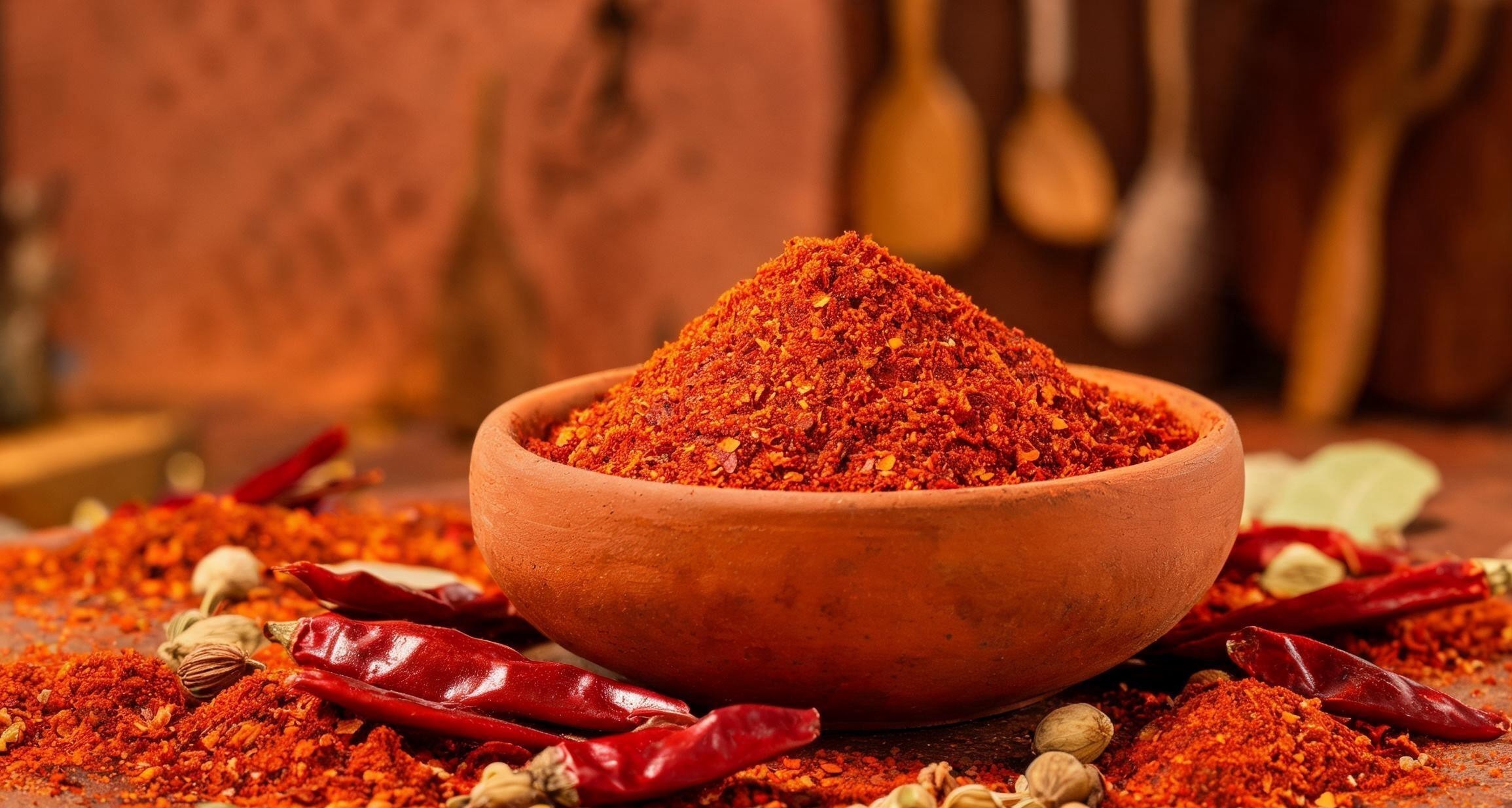
Berbere holds Ethiopian cooking together, and you can't fake it with cayenne and paprika. Abeba makes her own from dried guinea pepper, bird's eye chilies, fenugreek, coriander, cardamom, and a few other ingredients, toasted and ground in batches. It is hot, but not one-dimensionally — the heat builds and fades, and underneath you taste the sweetness of the chilies, the earth of the fenugreek, and the floral note of the cardamom.
The other wots were misir wot, a red lentil stew, and gomen, collard greens with onions and garlic. The gomen was my favorite, maybe because I grew up eating Korean collard greens and recognized the idea. Abeba cooks the greens until they're almost melting, with plenty of garlic and a little berbere.
We ate on low stools in Abeba's living room, the platter between us. Menna was there, and Tesfaye, and two neighbors who had dropped by without calling, which is normal. In Ethiopia, meals are not private events. People show up. Abeba made injera for eight people even though only five were expected, because she knew someone might arrive. That is not hospitality as a performance. It is just how things work here.
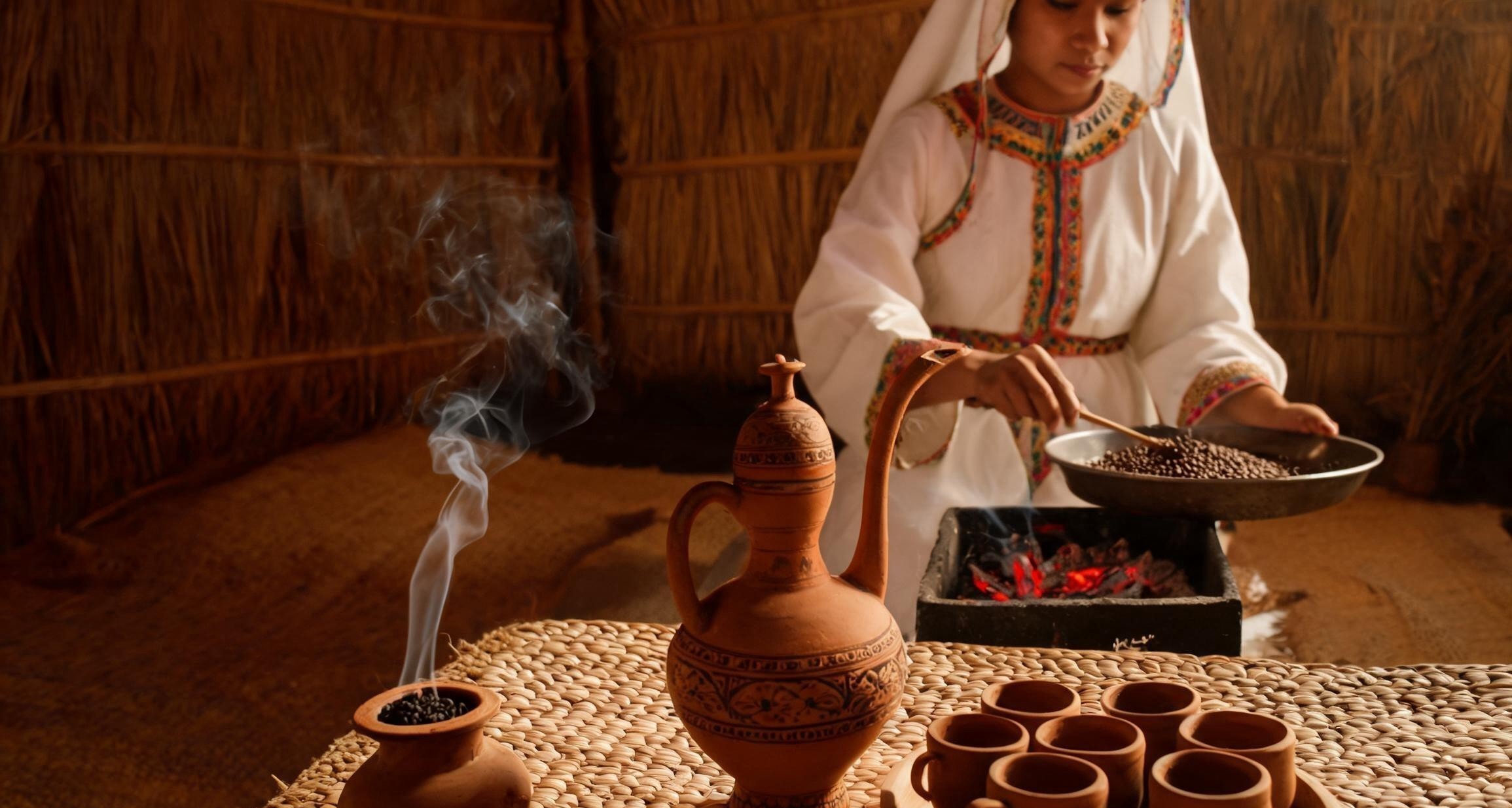
After the meal, Abeba began the coffee ceremony — not a formal event, just the way coffee is served in Ethiopian homes for centuries. She roasted green beans in a small pan over a charcoal burner right at the table. The smell filled the room — smoky, sweet, intense. She shook the pan until dark brown, ground the beans by hand, and put them into a clay pot called a jebena with water to boil.
The coffee is poured into small handleless cups with sugar but no milk. Abeba poured the first round, abol, then tona, then bereka, each weaker than the last. The whole process takes about an hour. It is not about caffeine. It is about sitting down and talking. Abeba poured, we drank, Tesfaye told a story, Menna argued with a neighbor about politics, and nobody was in a hurry to leave.
For anyone making injera at home, the biggest challenge is getting teff flour. In the U.S., it is available at Ethiopian markets in cities like Washington D.C., Los Angeles, Seattle, and Atlanta, or online. It runs eight to twelve dollars for a two-pound bag. If you can't find it, a blend of buckwheat and sorghum flour works, though the flavor will be different. Abeba's rule: pure teff or nothing.
For fermentation at home, keep the batter warm, around eighty-five degrees — near the stove or in a warm corner. In a colder kitchen you might need a pinch of instant yeast, though Abeba wrinkled her nose at that. "That is not real injera," she said. "But if you are in America, do what you can." Let it ferment two to three days until the batter smells tangy with small bubbles on the surface.
Cook injera on a large non-stick skillet or crepe pan over medium-low heat. Pour the batter in a thin circle, cover, and cook about two minutes without flipping. The top should be set with visible bubbles, the bottom releasing easily. Stack finished pieces and cover with a clean towel.
I left Abeba's house at noon with leftover injera, a jar of her berbere, and a better sense of why this food matters. Injera is not a trend. It is daily sustenance, a piece of cultural identity that Ethiopians carry with them wherever they go. When I saw Menna in Los Angeles months later, she told me her mother had shipped a bag of teff flour to her apartment because she didn't trust what was available here. I understood why. Some things are worth getting right.