I watched an eighty-year-old woman named Nonna Rosa roll out a sheet of pasta dough on her kitchen table in Bologna using an empty wine bottle. She did not own a pasta machine. She never had. The bottle was a Chianti fiasco, the round-bottomed kind that you used to see in straw baskets at Italian-American restaurants in the 1980s, and she had been using it as a rolling pin for decades. The flour on her table was Caputo 00, and the eggs came from chickens her neighbor kept in a yard down the lane. She worked quickly, pressing the bottle forward with both hands, rotating the dough a quarter turn after each pass, until the sheet was thin enough to read a newspaper through. That sheet of pasta became the tagliatelle we ate fifteen minutes later with ragu, and it was the best pasta I have had in my life. I went home to Portland and started making pasta myself. I do not own a machine either.
The recipe is as simple as it gets. You need two ingredients: flour and eggs. The standard ratio is one large egg per 100 grams of flour. For two people, which is a reasonable starting batch, crack two eggs into a bowl and weigh them. If the eggs total about 110 grams, use 200 grams of flour. If the eggs are on the smaller side, closer to 95 grams each, stick to the same 100-gram-per-egg rule and use slightly less flour. The exact measurement matters less than you think it does. You are going to adjust the dough as you knead it, adding a pinch more flour if it is too sticky or a drop of water if it is too dry. The dough will tell you what it needs if you pay attention to how it feels under your hands.
The flour matters more than most recipes let on. Italian 00 flour, which is milled to a very fine texture and has a lower protein content than American all-purpose, produces a softer, more tender dough. If you can find Caputo 00 or a similar brand at an Italian market or online, use it. If not, all-purpose flour works fine. I have made this dough with standard King Arthur all-purpose more times than I can count, and the pasta was still noticeably better than anything dried from a box. The texture will be slightly chewier with all-purpose, and the color a little less golden, but it works. Do not use bread flour. The protein content is too high and the dough will be tough and elastic in an unpleasant way.
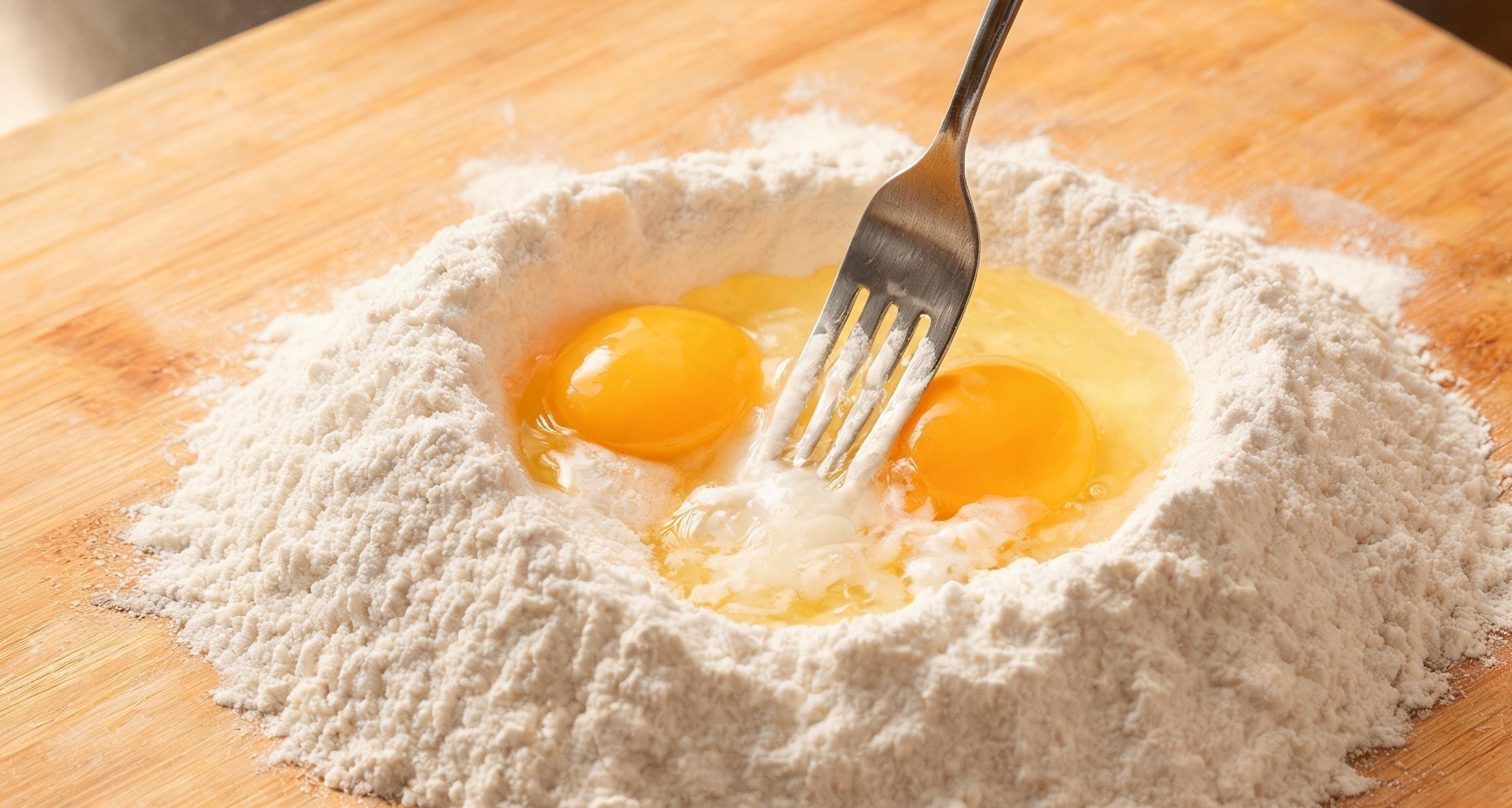
Pour your flour onto a clean work surface -- a wooden board or a large cutting board is ideal, but a clean countertop works too -- and shape it into a mound. Use your fingers or the back of a spoon to create a deep well in the center, like a wide volcano. Crack the eggs into the well. Take a fork and beat the eggs gently, drawing in small amounts of flour from the inner walls of the well as you go. Work slowly at first. If you rush this step, the walls of flour will collapse and the eggs will run everywhere, which is messy but not the end of the world. Just push the mixture back together with a bench scraper. As the eggs and flour start to combine, the mixture will get thicker and shaggier. At some point, you will need to abandon the fork and use your hands. Bring the loose bits of dough together into a rough ball and start kneading.
Kneading fresh pasta dough takes eight to ten minutes by hand. Press the heel of your palm into the dough, push it forward and slightly down, fold the dough in half toward you, give it a quarter turn, and repeat. That is the basic motion. For the first few minutes, the dough will feel rough and may stick to your hands or the board. Dust your hands and the board with flour as needed, but do not add too much. The surface of the dough should start to smooth out after about five minutes of kneading. Keep going. The dough is ready when it is smooth, elastic, and springs back slightly when you press your thumb into it. It should feel like firm Play-Doh. Wrap the dough tightly in plastic wrap and let it rest at room temperature for thirty minutes. This rest is not optional. The gluten needs time to relax, and the flour needs to fully hydrate. If you skip it, the dough will fight you when you try to roll it out.
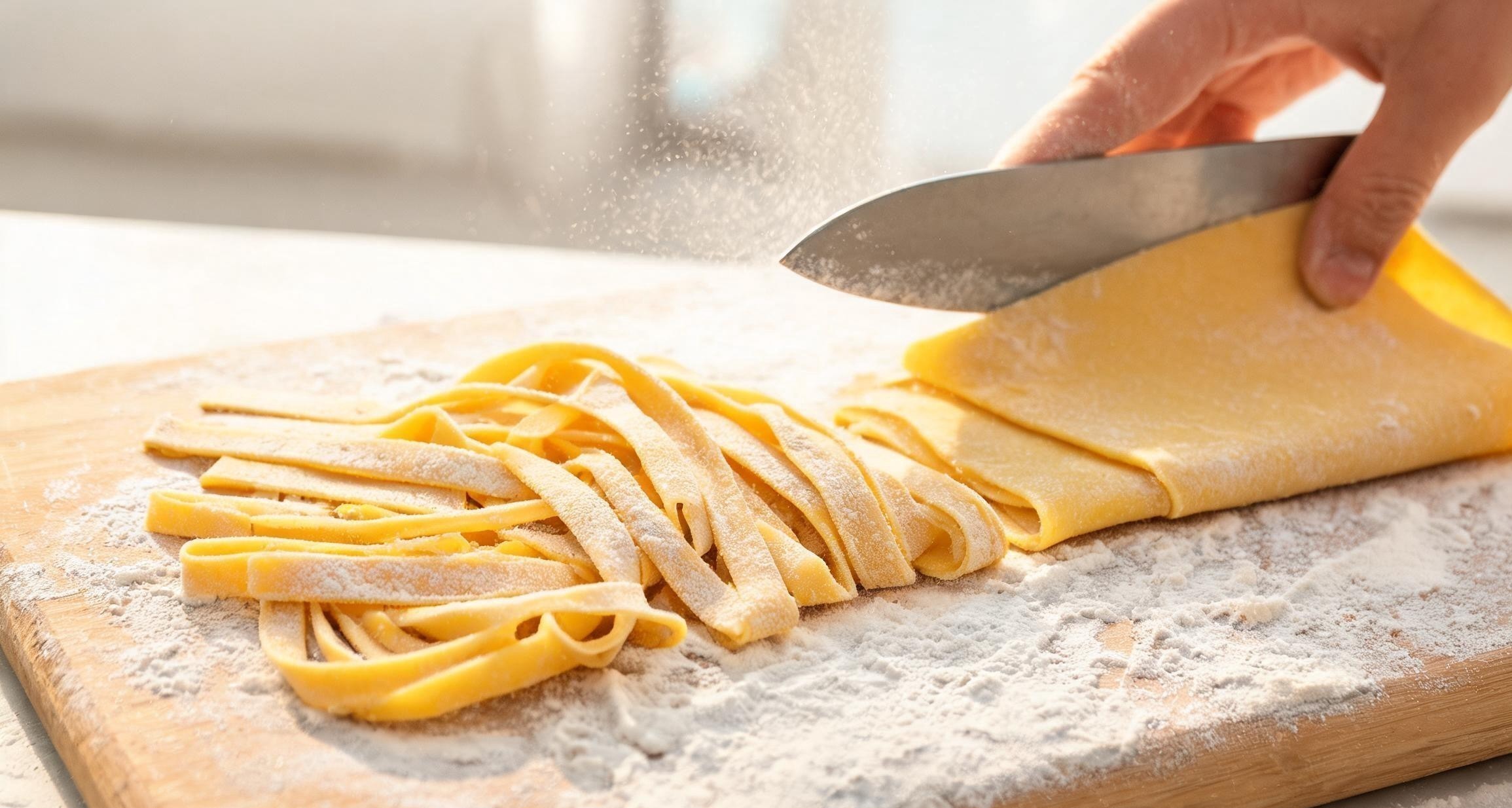
After the rest, cut the dough into four equal pieces. Work with one piece at a time and keep the others wrapped so they do not dry out. Flatten the piece with your hands into a rough oval, then start rolling with a rolling pin. Roll from the center outward, applying even pressure, and rotate the dough frequently so it stretches uniformly. The goal is to roll it thin enough that you can vaguely see the shadow of your hand through it, about one millimeter thick. Be patient. The first few times you do this, the sheet will be thicker in some spots and thinner in others. That is normal. Your arms will get tired. Rest for a minute if you need to. The dough will wait for you.
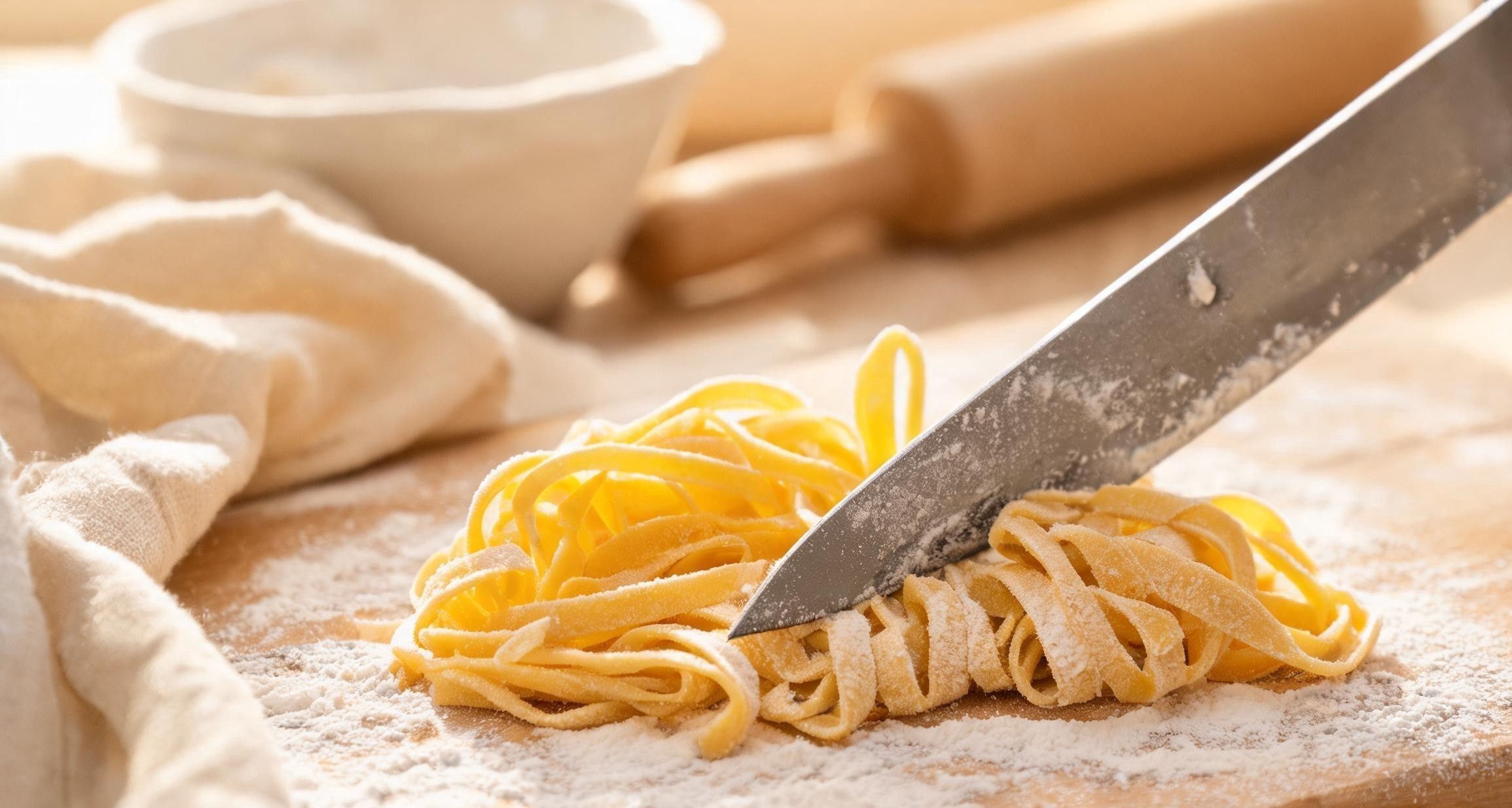
Once the sheet is rolled out, dust it lightly with flour on both sides and fold it over on itself a few times, like a letter. Use a sharp knife -- a chef's knife works well, or a pizza cutter if you prefer -- to cut the folded dough into strips. For fettuccine, aim for strips about a quarter inch wide. For pappardelle, make them wider, about an inch. Unfold the strips immediately and toss them with a little more flour so they do not stick together. Lay them in loose nests on a floured baking sheet or hang them over the back of a chair. They do not need to dry. You can cook them right away.
I should be honest about the learning curve. Your first batch of pasta will probably be uneven. Some strips will be too thick. Some will tear when you try to lift them. The dough might stick to the rolling pin. My first batch, the one I made the week after I got home from Bologna, was a mess. The noodles were different widths, some nearly an inch wide and others barely thicker than a shoelace. They tasted good, though. They tasted like actual pasta. That is the thing that keeps you going. Even imperfect fresh egg pasta, rolled by hand with two ingredients, is better than anything dried from a box. Each time you make it, the rolling gets a little more even, the strips get a little more uniform, and your arms stop hurting. After four or five batches, you will start to feel like you know what you are doing. After ten, you will not think about it at all. You will just make pasta.