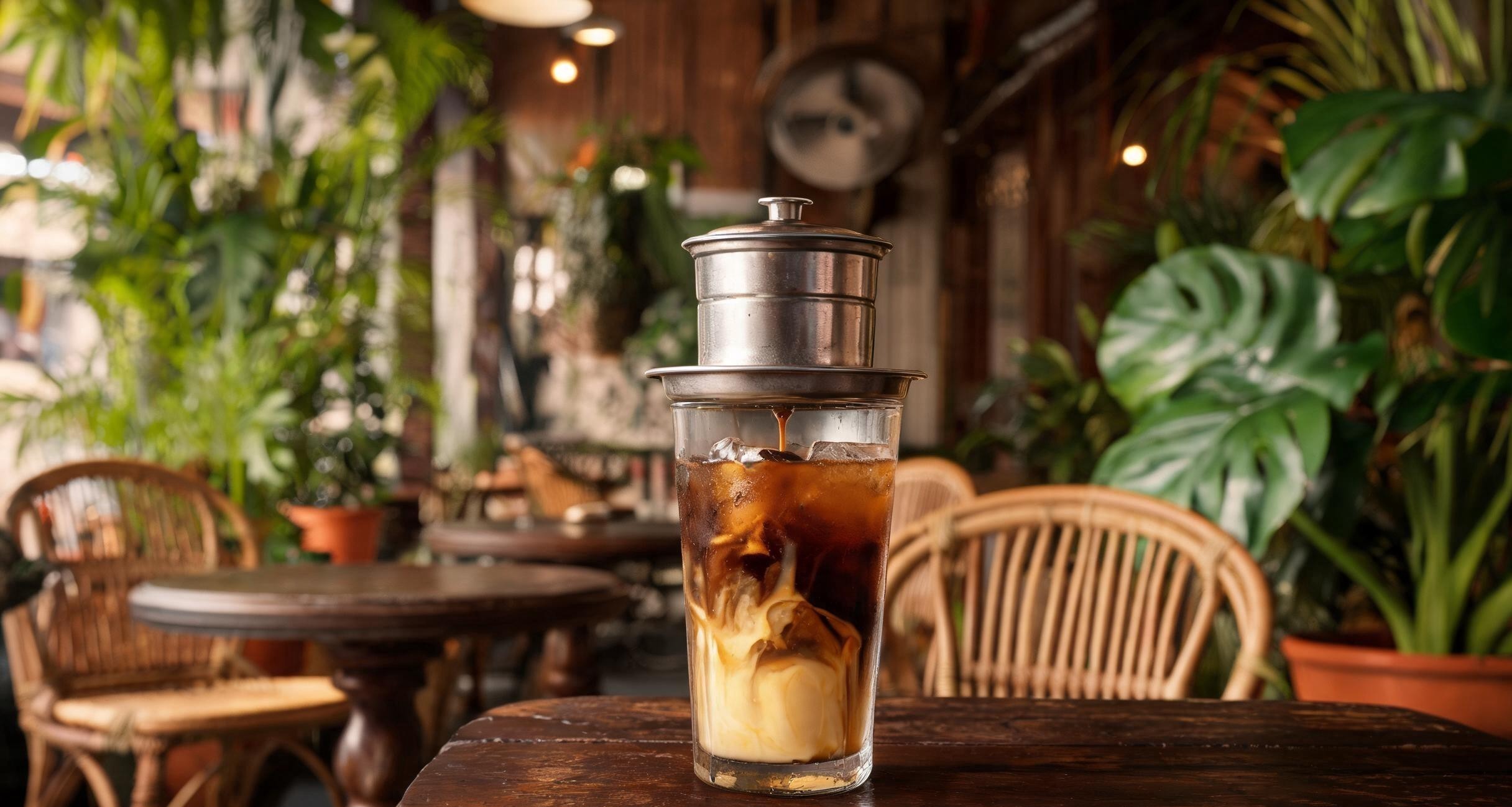
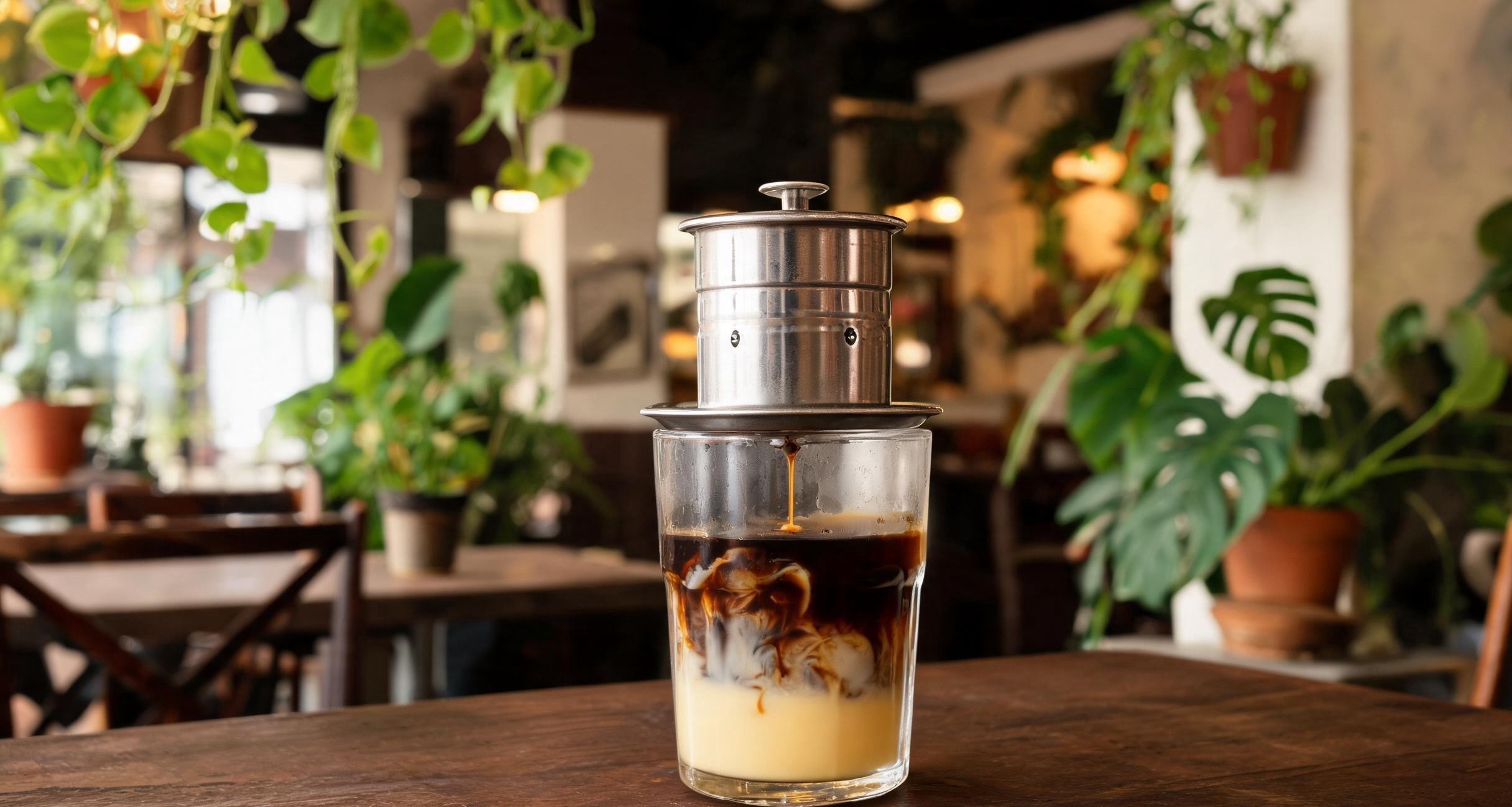
The first ca phe sua da I had in Saigon was at a plastic stool on the corner of Nguyen Thi Minh Khai and Cach Mang Thang Tam. The stool was pink and low to the ground, the kind that makes your knees stick up above the table. An elderly man with a tank top and flip-flops placed a small aluminum drip filter on top of my glass, added two spoonfuls of condensed milk, and poured hot water from a thermos into the top of the filter. Then he walked away. I sat there for what felt like twenty minutes, watching the dark coffee drip, drip, drip into the condensed milk pooling at the bottom of the glass. No one was in a hurry. The street noise was constant but it became background noise, the way traffic does when you stop paying attention to it. When the dripping finally stopped, I stirred the coffee and condensed milk together and took a sip. It was sweet, strong, and cold, with a bitterness that came through the sugar and stayed on the back of my tongue. I had been drinking coffee for twenty years and this was the first time it felt like a complete experience rather than a caffeine delivery system.
Vietnamese coffee culture runs on condensed milk, and that is not something you can substitute. The canned sweetened condensed milk sold in Vietnamese markets, brands like Longevity and Eagle, has a particular caramel sweetness and a thickness that fresh milk cannot replicate. When you stir it into dark-roasted coffee, usually a blend of robusta and arabica with chicory added, the result is a drink that is simultaneously bitter and syrupy, with a weight to it that makes you slow down. Vietnamese coffee is not something you gulp on the way to work. It requires sitting. The phin filter, that small aluminum device with tiny perforations, controls the pace. It takes five to ten minutes for a single cup, and that pacing is intentional. The coffee is a reason to stop, which in a city that moves as fast as Saigon is a radical act.
The egg coffee at Cafe Giang near Hoan Kiem Lake is a different animal entirely. Nguyen Van Giang started making egg coffee in 1946, during a time when fresh milk was scarce in Vietnam. His solution was to whisk egg yolks with sugar and condensed milk into a thick, frothy custard and pour hot espresso over it. The result sits in a small cup in two distinct layers: dark coffee on the bottom, pale yellow foam on top. You stir them together right before drinking, and what you get is a drink that tastes like a liquid tiramisu, warm and sweet and slightly eggy, with the coffee cutting through the richness just enough to keep it from being dessert. The cafe itself is tiny, accessible through a narrow alley that most tourists walk right past. I found it on my third trip to Hanoi, after a local friend finally wrote the address on a napkin for me. It was worth every wrong turn.
The cafe scene in Saigon has changed dramatically in the last decade. Rooftop cafes with exposed brick and single-origin beans have opened in District 1 and District 3, catering to a younger crowd that wants pour-over and flat whites alongside their traditional ca phe sua da. Places like Workshop Coffee and The Observatory have become gathering spots for freelancers and tourists, with fast Wi-Fi and air conditioning. I do not begrudge any of this. The new cafes are well-run and the coffee is technically excellent. But they are missing the thing that makes Vietnamese coffee special, which is the friction between the drink and the environment. A ca phe sua da tastes better on a pink plastic stool on a noisy sidewalk than it does in an air-conditioned room with reclaimed wood tables. The heat, the noise, the wait for the phin to finish dripping: these are not inconveniences. They are part of the experience.
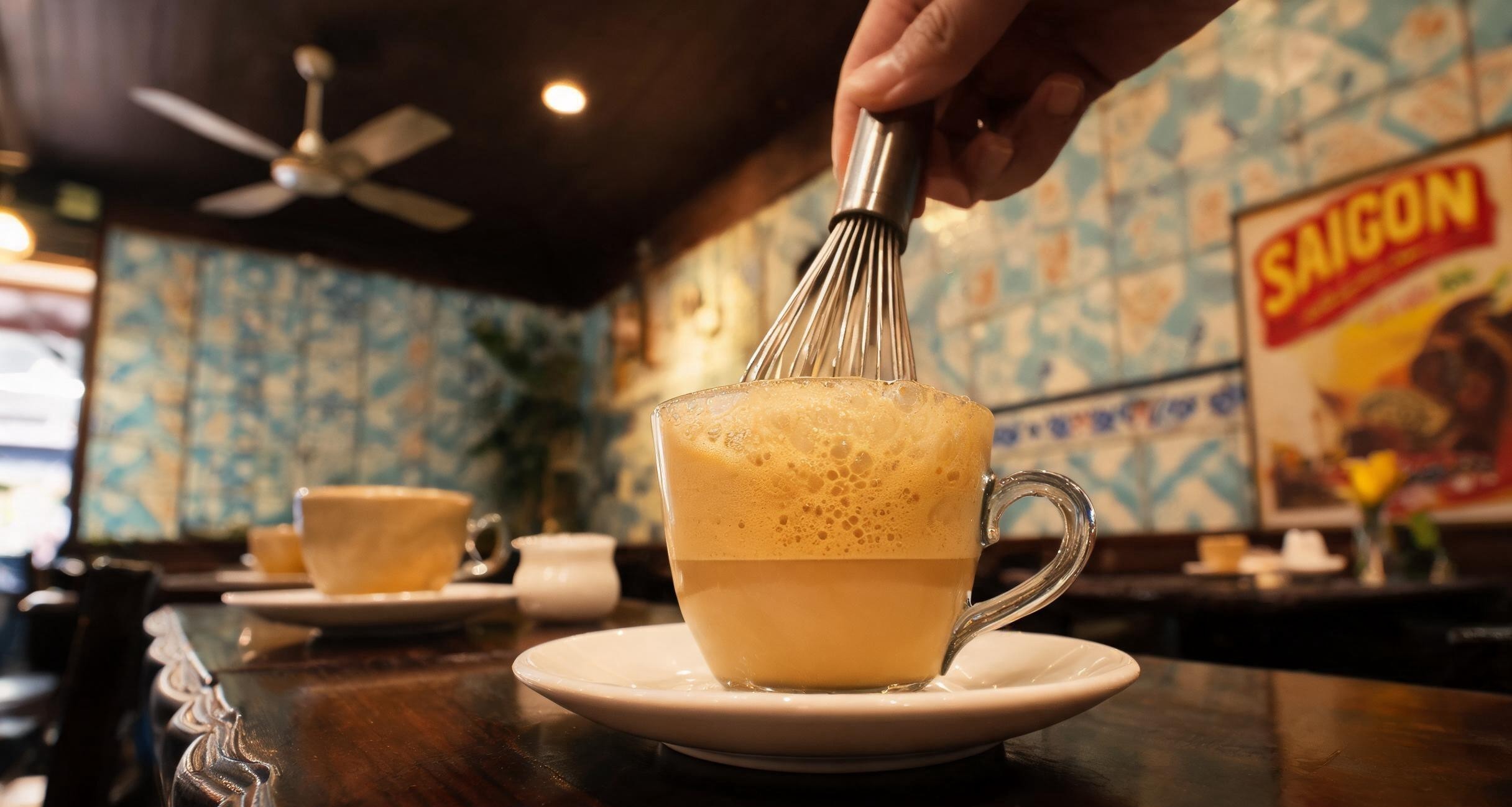
There are coffee shops in Saigon that have been open for generations, run by families who have been roasting their own beans the same way since before the war. I visited one on Trieu Viet Vuong Street where the owner, a woman in her seventies, still roasts coffee in a small drum roaster in the back of the shop, over a wood fire. The aroma of freshly roasted beans hits you before you even walk through the door. She serves coffee in old ceramic cups that have been refilled ten thousand times, and the brew is thick and dark with a roasted, almost smoky edge that comes from the wood roasting. There is no menu. There is one coffee. You sit on a wooden chair that has been there for decades, and you drink it while the owner watches the street from behind her counter. The whole visit takes twenty minutes, and you leave feeling like you have been somewhere, not just consumed something.
What makes coffee in Saigon different from coffee anywhere else is not the beans or the method or the milk. It is the attitude. Coffee here is not fuel. It is not a status symbol or an Instagram prop. It is a pause built into the day, a moment where you sit still and let the city happen around you. Whether you are at a rooftop spot overlooking the skyline or on a broken stool in an alley, the coffee is secondary to the act of stopping. That is what the rest of the world could learn from Saigon: that the best cup of coffee might be the one you have to wait for, in a place that makes no apologies for being slow.