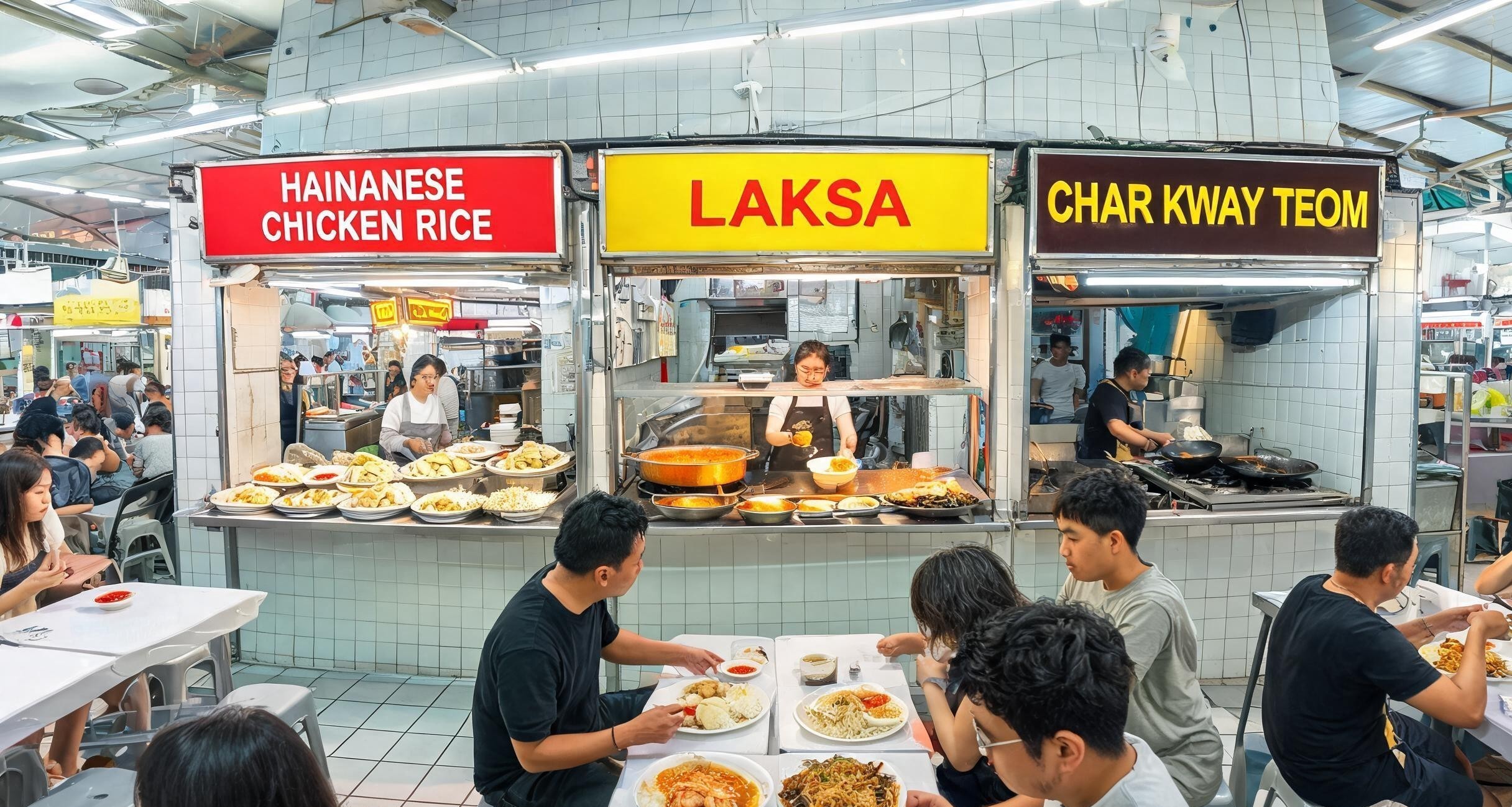
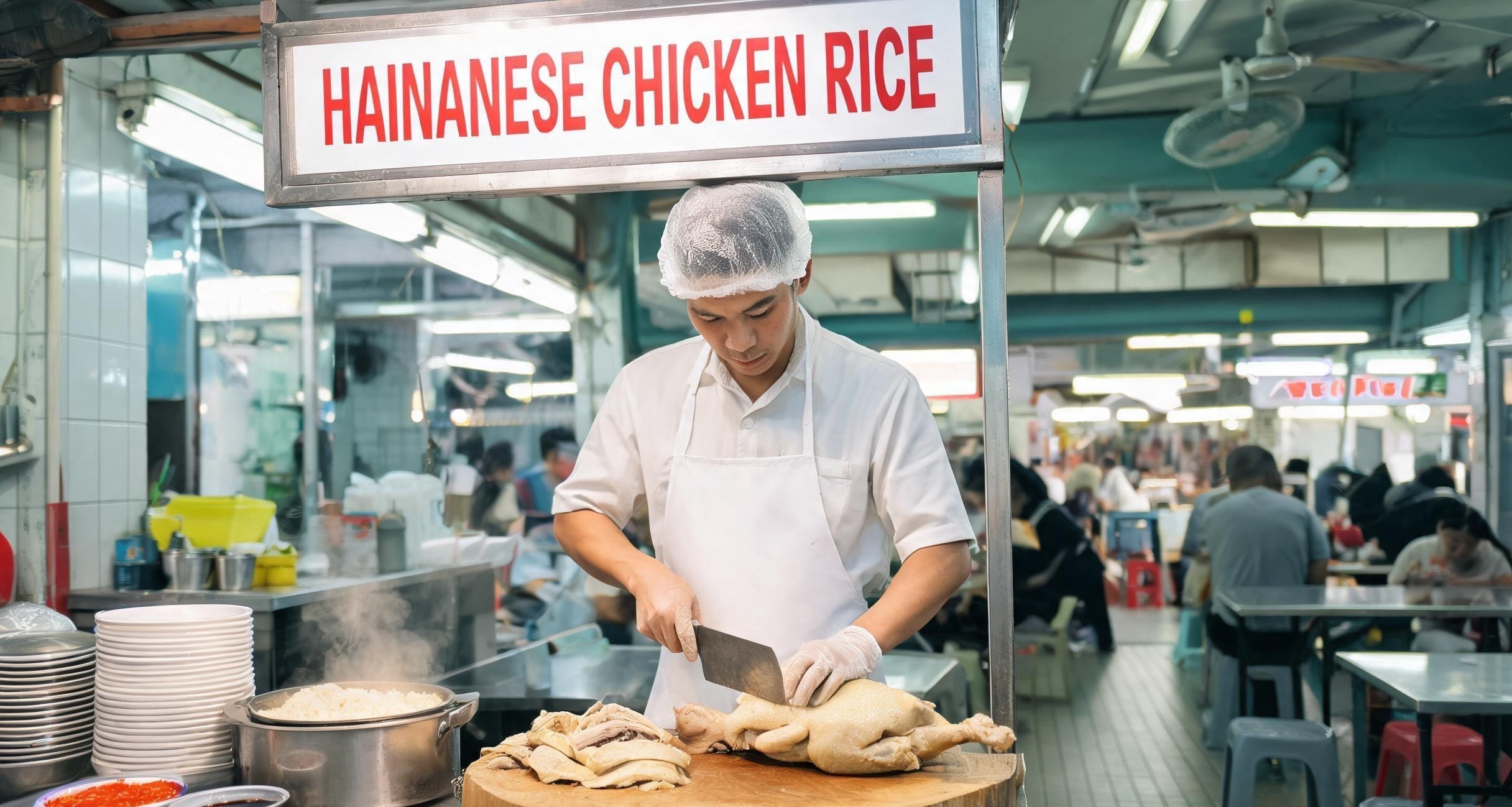
The line at Tian Tian Hainanese Chicken Rice starts forming at ten in the morning, even though the stall does not open until eleven. By noon, the wait is forty-five minutes. By one o'clock, they start running out of chicken. I got there at ten-thirty on a Wednesday and was twelfth in line, which meant I had about thirty minutes to stand in the humid heat of the Maxwell Food Centre and think about whether a plate of chicken and rice could possibly be worth this much waiting. When I finally sat down with my food, I understood why people do this every day. The chicken was poached so precisely that the meat was silky and barely opaque, served at room temperature with a skin so thin and delicate that it barely held together when I picked it up with chopsticks. The rice, cooked in the chicken fat and broth, was fragrant with ginger and pandan, each grain separate and glossy. The dipping sauces, a dark soy and ginger, a chili sauce, and a thick paste of pounded ginger and scallion, completed the plate. It was a simple dish executed with a precision that made it extraordinary.
Not every hawker stall in Singapore has a Michelin star, and not every good hawker stall needs one. At the Chinatown Complex Food Centre, a sprawling two-story market with over two hundred stalls, I found a woman named Madam Ong running a zi char stall called Zi Yean that has no stars, no social media presence, and a line that is almost as long as Tian Tian's. Her specialty is white bee hoon, thin rice noodles stir-fried with pork, prawns, cabbage, and egg in a light soy-based sauce. The noodles are wok-tossed over high heat, and they arrive at the table with a smoky quality called wok hei that is difficult to achieve and immediately recognizable when you taste it. Madam Ong has been running the stall for over twenty years, and her wok is seasoned with two decades of use. That seasoning is part of the flavor, and it is not something a new stall can replicate.
The third hawker center I visited was the Tiong Bahru Market, a smaller, older market in a residential neighborhood west of the city center. I went for the chwee kueh at a stall called Jian Bo Shui Kueh, which has been operating since the 1950s. Chwee kueh are small steamed rice cakes, soft and slightly wobbly, topped with a generous spoonful of preserved radish that has been stir-fried with dried shrimp and chili. The cakes themselves are bland, which is the point. The flavor comes entirely from the topping and the chili sauce you drizzle on top. Each order comes in a small paper tray, four or five cakes, and you eat them standing at a counter or on a bench. They cost two dollars for a portion. They are the cheapest, most satisfying thing I ate in Singapore, and the fact that they have been made the same way for seventy years at the same market stall tells you something about how Singaporeans value their hawker food.
Singapore's hawker culture was added to the UNESCO Intangible Cultural Heritage list in 2020, and the recognition was both a celebration and a warning. The average age of a hawker in Singapore is over sixty, and fewer young people are taking up the trade. The hours are brutal, starting before dawn and lasting until the food runs out, often ten to twelve hours a day in a hot, crowded stall. The pay is modest. Many of the most famous hawker dishes are sold at prices that have barely increased in a decade, because the customers, who are mostly working-class Singaporeans, would not accept a significant price increase. The Michelin stars have brought attention and tourism, but they have also brought a kind of pressure that does not always serve the food well. Some hawker stalls now have longer lines because of their star rating, which means more work for the same amount of money, and the stall owners are not young enough to handle the increased volume.
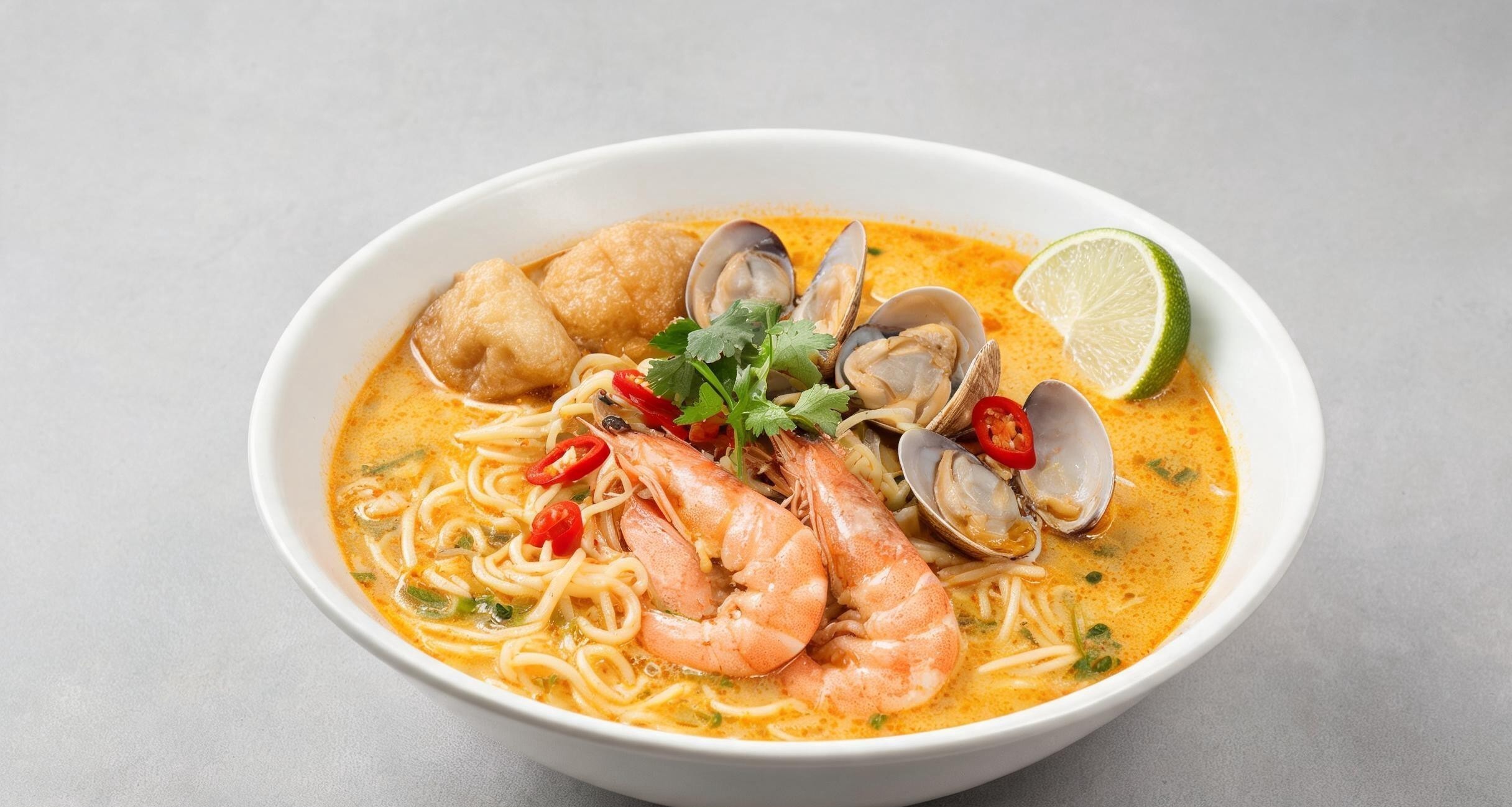
What makes hawker centers special is not any single dish. It is the system itself: dozens of independent cooks, each specializing in a few items, all gathered in one place, competing for customers who vote with their feet every single day. If a hawker's food is not good, the line disappears, and the stall does not survive. There is no marketing team, no PR firm, no influencer partnership to save a bad cook. The food has to stand on its own, three meals a day, year after year. That kind of accountability produces a quality of food that no amount of money or fame can replicate. The hawker center is not a food court. It is a food ecosystem, and it is one of the few places left in the world where you can eat a truly excellent meal for five dollars.
I ate at hawker centers for every meal during my week in Singapore, and I did not have a bad plate of food the entire time. Not once. That consistency is remarkable, and it is a direct result of the competitive environment. At each hawker center, multiple stalls serve similar dishes, and the customer can see which stalls have long lines and which do not. There is no hiding behind a marketing budget or a trendy location. The food either draws a crowd or it does not, and the stalls that survive year after year are the ones that consistently produce excellent food at low prices. It is the most honest food system I have encountered anywhere in the world, and it produces results that any restaurant in any city would be proud of. Singapore's hawker centers are proof that great food does not require a great restaurant. It requires a great cook, good ingredients, and customers who care enough to show up every day.